Friday, 3 February 2023

20. Rice Production Technology

 Rice


Scientific Name:

Oryza sativa L.

Rice Botany:

  • It's miles a self-pollinated plant. 
  • It produces four to five tillers. 
  • The stem or culm is hollow, erect, and accessible. 
  • It consists of nodes and internodes. 
  • The leaf consists of a long, slim leaf blade and a loose-leaf sheath with generally long ligules. 
  • The inflorescence is unfastened, with many-branched panicles, every bearing many spikelets. 
  • The root system is shallow and consequently concentrates in the topsoil layer to an intensity of 20 to 25 cm. 
  • It consists of seminal or seed root, and adventitious root, arising from nodes close to the soil surface. Safe-to-eat seeds are borne in a dense head (called panicle) on separate stalks. It's miles a long day plant that's self-pollinated.

Economic Importance of Rice:

  • It's by far the critical meal crop of the world and is the staple meal in South East Asia at present extra than half of the global populace relies upon this crop for its nutritional wishes. It occupies 2nd function after wheat in Pakistan and plays an important position in Pakistan’s economic system as billions of bucks are earned yearly by its export. 
  • In Pakistan, all through the year 2018-19 its region is 2.8 million ha with a total manufacturing of 7.20 million tons with an average paddy yield of 2562 kg/ha.

Production Technology of Rice:

  • The nursery must not be sown before 20 May to prevent the rice from the attack by insects.
  • Super Basmati, Basmati 385, PK 386, and Chenab Basmati these varieties have the time of sowing for their nursery is 1st June-20 June and the time of planting for this is 1st July-20 July.

Methods for nursery sowing:

These the following three which discussed given below:

  • wet bed method
  • Dry bed method
  • Raab method

Wet bed method:

  • Soak the seed in water for twenty-four hours, after that cover the source with moist jute bags and area it beneath the shade.
  • The seed will germinate after 36-forty eight hours.
  • Irrigate, plow, puddle, and degree the sector.
  • Put together beds of 1 to 1.5 m width, 4-five cm height & any convenient period.
  • Germinated seed is sown with broadcast technique @ 1kg/Marla for ARRI sorts and @ 500-750g/Marla for Basmati types.
  • 1-1. Five-inch water should be a gift before broadcasting the pre-germinated seed at night.
  • Drainage the water the next night and irrigate it in the subsequent morning. Repeat it for one week.
  • Preserve a water level of two-5 cm, depending on the peak of seedlings.
  • If the seedling weakens, observe urea 250g in line with Marla.
  • Seedlings might be ready for transplanting in 25-30 days.

Dry Bed Method:

  • Practiced wherein puddling is not possible as soils are loamy or silt loam.
  • The plot is ready in water situations after irrigation.
  • Dry seed is sown with broadcast method @ 1.5 kg/Marla for ARRI varieties and 750g/Marla for Basmati varieties.
  • The straw layer is spread and irrigation is implemented.
  • The straw layer is eliminated after some days to facilitate sunlight.
  • The seedling might be ready in 35-40 days.

Raab method:

  • Practiced in areas of D.G. Khan and Muzaffargarh wherein soil is challenging.
  • The uprooting of the nursery is tough.
  • Nursery plots are leveled.
  • Crop residues (5cm layer) spread uniformly and burnt.
  • Ash is pressed on the soil after cooling.
  • Dry seed is sown with broadcast approach @ 2kg/Marla for ARRI sorts and @ 1kg/Marla for Basmati varieties.
  • The seedling can be prepared in 35-40 days.


Land Preparation for Transplanting:

  • Irrigate the sector until the status water situation is a minimum of three days before puddling.
  • In wetlands, a waterproof layer is created at an intensity of about 20cm.
  • Degree the sphere during puddling.
  • Use ‘Raja Hal” in high clayey soils with more water availability earlier than puddling.
  • Transplant the nursery as quickly as feasible after area guidance.
  • Puddling isn't always executed in salt-affected soils as salts will no longer leach down.

Transplanting:

  • Seedling age needs at most 30-forty days on the transplanting.
  • Irrigate the sector 1-2 days before uprooting the seedling as it facilitates the uprooting.
  • Transplanting must be executed in 1. Five-inch-deep water.
  • Maintain water depth at 1.5 inches for the first week of transplanting annat at 3 inches.
  • Do now not use damaged or diseased flowers for transplanting.
  • Use two flora in keeping with hollow with a nine × 9-inch distance.
  • As 80000 holes and 160000 plants in line with acre.
  • Location some seedling bundles near field banks in water to refill the gaps in 7-10 days’ length.

Fertilizer Application:

  • IRRI-6, KS282, KSK133, and KSK 434 when sown after wheat then apply N 69, P 41, K 32 form urea, SSP, and K2SO4. 

Irrigation:

  • Standing water has to be present in the rice field for 25-30 days after transplanting.
  • Water intensity must be 1-2 inches.
  • Stop irrigation before 15 days of ripening.

Measures for Plant Protection:

  • All weeds should be removed within a month after transplanting.
  • Weeds reduce the yield and deteriorate the high quality.
  • The crop rotation method allows governing weeds.
  • Keep the water stage up to three inches for 30 days if available.
  • Use recommended herbicide 3-five to days after transplanting.
  • Consult the rural professionals for endorsed herbicides.
  • Do now not let the sphere dry for one week after the herbicide utility

Diseases Treatment:

  • Use sickness-resistant sorts.
  • Treat the seed with encouraged fungicide.
  • Burn the crop residues after harvesting.
  • Concern the agriculture workforce for in addition steerage.

Insect Control:

  • Damage the insect eggs and nymphs.
  • Use alternative plant life or weeds for insect feed.
  • Biological manipulation techniques also can be used.
  • The light trapper can also help to govern bugs.
  • Crop rotation can reduce the probability of insect attack.
  • Use suitable insecticides for bugs.

Harvesting of Rice:

  • Timely harvesting is essential for optimum yield.
  • 20-22% moisture in grain is an excellent time for harvesting.
  • After harvesting yield must be reached in the market well timed.
  • Save the product after 4-6 days of drying (at 12-13 % moisture).
  • Traditional harvesting is an extra complex and time-eating method.


Rice Varieties:

    Pakistan is one of the most important manufacturers and customers of rice. A number of the generally grown and fed rice sorts in Pakistan include:

  1. Basmati Rice - a protracted grain, fragrant rice with a sensitive taste
  2. IRRI Rice - medium grain rice, broadly grown inside the Indus Valley area
  3. D-98 Rice - an excessive-yielding type of IRRI rice, regarded for its company texture
  4. PUSA Basmati Rice - a diffusion of Basmati rice with an exceptional aroma and flavor
  5. Kainat Rice - a hybrid variety of Basmati rice, recognized for its outstanding cooking first-rate
  6. Splendid Basmati Rice - a high-yielding form of Basmati rice, regarded for its lengthy grain length.

    These are a number of the famous rice varieties grown and consumed in Pakistan.

NOTE:

If you find more details about each topic then visit the link which is pinned in each topic.

References:

1

2

3

4

5

6

7

8

19. Wheat Production Technology

Wheat

Scientific Name:

Tritichum Aestivum L


Introduction:

  1. Wheat is grown on different land areas globally than other crops and is close to 1/3 of rice and corn in total world production.
  2. With manufacturing achieving ten times in 5 years, India is the second largest wheat producer in the world.
  3. Various research and researches display that wheat and wheat flour play a more and more vital function within the control of the Indian meals economy.
  4. Wheat production is set at 70 million tonnes consistent with yr in India and counts for approximately 12 compatible with cent of global manufacturing.
  5. Being the second biggest in population, it's also the second biggest in wheat consumption after China, with a significant and developing wheat demand.
  6. Essential wheat-developing states in India are Uttar Pradesh, Punjab, Haryana, Rajasthan, Madhya Pradesh, Gujarat, and Bihar. All of the north is replenished with wheat cultivation.
  7. Wheat has a slender geographic land base for manufacturing as compared to rice or pulses. Wheat is a temperate crop requiring low temperatures and most of the country is tropical.
  8. India's wheat production increase is pushed basically by yield increase and via a shift in production from other crops to wheat and a boom in cropping intensity.
  9. Some of the principal elements that affect yield, fertilizer use seems to have much less effect in the latest years at the same time as growth in irrigated and high-yielding variety (HYV) places appear to play a more important role in raising yield.
  10. Relying on the population and profits growth, poverty comfort, and the price of urbanization, a call for-deliver gap may also open at the cost of about 1 to two cents according to year, which is equal to zero.7 to at least one. Four, million tonnes of wheat, growing hefty over the years.
  11. Promoting fast financial improvement and earnings growth in India which embraces the terrible and especially the rural bad may result in considerable growth in the call for wheat and for that reason a diffusion in alternate possibilities.

Economic Importance of Wheat:

  • Wheat by myself accounts for 14 percent of the cost added in agriculture and provides three percent of the country’s GDP in line with the Ministry Of Finance (2009). Wheat is the maximum vital agricultural crop; Its miles grew through approximately eighty percent of farmers on about nine million ha, Which is close to 40 percent of the country’s general cultivated land, According to reliable assets in Pakistan.
  • The crop also has money owed for an expected 37 percent of both meal's energy and protein intakes. Its miles therefore the single maximum critical meal crop in Pakistan. Those elements exhibit the position and importance of wheat in Pakistan’s economy and public support to the agriculture region.

Production Technology:

Seed-bed preparation:

    2-3 ploughings and 2 cultivations followed using planking are enough to put together a seed bed.

Sowing Time:

  • It's miles rabi season crop. In barani regions: 20th October – tenth November
  • In irrigated regions, the optimum sowing time is 1st November – fifteenth November
  • Sowing after November results in 10-12 kg grain yield reduction in step with acre per day.

Seed Rate:

  • 40-50 kg/acre (60 kg/acre in case of December sowing). If germination is much less than 90%, then the seed charge should be multiplied.

Sowing Methods:

    In barani regions: Line sowing with pora or drill

  • In irrigated regions: Sowing with automated rabi drill is pleasant. If the drill isn't always to be had, then kera. Or seed may be broadcasted however seed fee should be multiplied by way of about five%.
  • In the case of overdue sowing or saline soils, shallow dry sowing observed by irrigation is the best.
  • According to care, the premier plant population of wheat is 10-12 lac flora.

Fertilizer:

  • Fertilizers should be implemented in line with the fertility repute of soil (in irrigated regions) and with rainfall (in barani areas). Less fertile soils require extra fertilizer and more significant rainfall regions require more fertilizer.
  • The full P and k have to be carried out in irrigated areas at seedbed education. However, N is applied in 2 splits, ½ N at seed mattress training and ½ N with 1st or 2nd irrigation.


Irrigation:

    It requires 3-4 irrigations:

  • 1st irrigation: 20-25 days after sowing (DAS) at Crown root initiation (CRI) degree (when adventitious root development starts offevolved), 30-40 DAS in rice areas.
  • 2nd irrigation: 15-45 DAS at tillering (wherein secondary shoots get up from the principal or primary shoot). Tiller is a shoot having its very own root, stem, leaves, and inflorescence. The first tiller arises 15 Das with a brand new tiller after every 4-five days and keeps until forty-five DAS. Irrigation throughout this level complements tiller development.
  • 3rd irrigation: eighty-90 DAS at the booting stage while the spike is growing inside the flag leaf and close to emergence.  Irrigation for the duration of this degree complements spike length and quantity of tillers according to the point.
  • 4th Irrigation: one hundred twenty-five-one hundred thirty DAS during milking degree of grain development. Irrigation at some stage in this stage will increase grain length and weight.
  • If sufficient water isn't always available, then lessen the variety of irrigations to 2-3 at the maximum essential crucial increase tiers i.e. CRI, booting, and milking stages.

Measures for plant protection:

Weeds:

15-20% discount in yield takes place because of weeds.

Cultural manipulation: 1. Daab (delayed planting) is performed with double rain irrigation.

2. Crop rotation wherein the wheat field is sown with some other rabi crop within the next season e.g. Berseem and many others. With it, tough weeds like wild oat or dumbi sitti are managed.

3. Hoeing or intercultural with bar harrow after 1st or second irrigation.

Chemical control: Pre-emergence herbicides e.g. Stomp or Treflan @ 1.3-2 L /acre for controlling BL weeds and grasses.


Post-emergence herbicides e.g. Buctril fantastic for BL weeds; topic, Puma is excellent for grasses.

Insect Pests:

  • Grasshoppers, crickets, aphids, armyworms, and white ants.
  • Grasshoppers and white ants assault at the seedling stage and are greater extreme in rainfed areas.
  • Aphid, Armyworm attack at heading.
  • A spray of suitable pesticides is recommended earlier than grain improvement.

Diseases:

    Stem rust, leaf rust, black rust, and stripe rust are severe. In team rust, brick-pink spore-containing pustules appear on all plant components in patches. In loose smut, floral parts are converted into a black powdery mass.

Harvesting:

    The crop matures when plants begin drying and yellowing. In-plane regions, regions of Punjab, wheat harvesting starts in mid-April and maintains until cease may also. In hilly areas, wheat is harvested in June and July. The crop is harvested via sickle or by integrated harvester or tractor set-up reapers. Combine harvester harvests in addition to threshing the crop

Storage:

    After harvesting, the grain has to be dried enough for safe storage. Luggage, bins, and stores must be fumigated to avoid the attack of saved grain pests and rats.

Varieties:

    Genetically resistant varieties like Akbar-19, Markaz-19, Ghazi -19, Anaj-17, Barani-17, Ujala-16, Jauhar-16, Fatehjang-16, Gold-sixteen, Borlaug-sixteen, Pakistan-13, Millet -eleven, NARC-11, AAS-11, Faisalabad-08, Fakhar e Bhakkar,  Bhakkar star, and Zincol are nevertheless recommended for cultivation in the field.

References:

1

2

3

4

5

6


Thursday, 2 February 2023

18. Different Types of Cropping systems used in Agriculture

 Cropping systems

Definition:

    It's far described as the order wherein the crops are grown or cultivated on a chunk or piece of land over a fixed duration.


Types of Cropping systems:

1. monoculture

2. Multiple cropping

3. Following or Fallow in rotation

1. Monoculture:

    The cultivation or growth of a single crop or organism mainly on agricultural or woodland land.

eg. Rice-Rice, Bajra-Bajra

Advantages:

  • Convenience in sowing with the help of machinery under mechanized farming.
  •  it's miles handy for harvesting with the help of equipment.

Disadvantages:

  • Now and then fertility and productivity of the soil are diminished if suitable soil management practices aren't followed.
  • Soil shape may deteriorate.
  • Growth infestation of pests, illnesses, and weeds.

2. Multiple Cropping:

    The cropping machine wherein two or greater vegetation is grown either in succession or sequence or association for the complete or part duration of their lifestyles cycles at equal discipline in a yr are called multiple cropping.

eg. Maize-Wheat-green gram

    It is further divided into two types:

  1. Parallel multiple cropping 
  2. Sequential multiple cropping

1. Parallel Multiple Cropping:

When two or more plants are grown in association for part of the complete duration of their lifestyles cycle is referred to as parallel multiple cropping. 

Advantages:

  • The threat of failure of the crop is less
  •  Fulfills the day-by-day necessities of meals grains, oilseeds, pulses, etc.
  •  Enhance fertility of the soil if legumes are taken as a minor crop
  •  Better distribution of labor via the cropped length
  •  Increase gross monetary returns
  •  Nicely balanced livestock feed is acquired
  •  Safeguards in opposition to pests and illnesses
  •  Full usage of area and to be had plant nutrients

Disadvantages:

  • Sometimes manipulation of pests, diseases, and weeds emerge as tough
  • A few instances impact the yield of the predominant crop
  • Harvesting with the assistance of equipment is not viable
  • Tough to perform unique subject operations with more labor requirement
  •  Due care is wanted whilst deciding on crop harvesting with the help of equipment is hard.
  •  Intercultural operations aren't feasible.
  •  Opposition to many of the resources is greater.
  •  Harvesting makes time ingesting/tough.

It consists of the following cropping systems:

  • Mixed Cropping
  • Intercropping
  • Relay Cropping
  • Alley Cropping
  • Multistroyed cropping

Mixed Cropping:

    Developing two or more crops concurrently and not using a distinct row arrangement is known as combined cropping.

eg. Maize+ Green gram + Pigeon pea

Intercropping:

    It's a far cropping system wherein intercrop is grown in between rows of the important crop, without affecting the finest plant populace in addition to yield of the primary crop (base crop) or developing or more vegetation concurrently at the equal piece land with distinct row associations is called intercropping.

eg. Maize, Pigeon pea (2:1)

Relay Cropping:

    It's far the cropping device in which the succeeding crop (next crop) is sown or planted whilst the first crop (preceding crop) has reached its physiological maturity stage or before it is ready to harvest is called relay cropping. eg. RiceLinseed/lentil/black gram/chickpea.

Alley Cropping:

    The machine of developing jawar, maize, bajra, or every other arable crop within the alleys (passage among rows) of leguminous shrubs like sublabel (Leucaena leucacephala) is referred to as alley cropping.

Multistroyed Cropping:

    In this system the plants of various top and vertical layers of leaf canopies, daylight requirements, and root systems are grown together on the same field is called multi-storeyed cropping.

eg. Growing pineapple, sweet potato, black pepper, etc. 

2. Sequential Multiple Cropping:

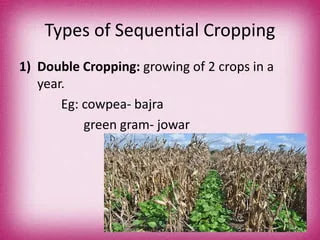
    Sequential Cropping involves growing vegetation within an equal area, one after the alternative within the same year.

Advantages:

  1. It increases the entire manufacturing and gross monetary returns from the unit area in a year.
  2.  Fulfills various wishes for food grains, pulses, oilseeds, vegetables, fodder, and many others.
  3.  Allows even distribution of labor at some point of the 12 months.
  4.  Better usage of land, labor, electricity, and different resources at the farm.
  5. Every day goes with the flow of income throughout the year.

Disadvantages:

  1. Fertility and productivity of the soil are decreased or exhausted if proper soil management practices are allowed.
  2. Every so often it influences the shape of the soil because of continuous cropping and irrigation.
  3. On occasion control of pests, diseases, and weeds become tough.

It has further two types:

1. Sequential cropping:

    It is the multiple cropping systems in which or greater vegetation is grown in sequence on an identical piece of land in a year or over a fixed length.

Types:

a. Double cropping


b. Triple cropping
c. Quadruple cropping

2. Ratooning:

    A crop rotation may be described as a more or much less systematic recurrent succession of plants on an identical piece of land.

eg. Jawar-Gram, Groundnut-Wheat

Note:

If you want to find more details about each system then visit the links which are given in each system. 

References:

1

2

3

4

5

6

7

8

9

10

11

12


Wednesday, 1 February 2023

17. Fisheries

 Fisheries

Definition:

    The technological know-how of producing fish and other aquatic sources for the reason of imparting human meals, although different targets are possible (inclusive of recreation or recreational fishing), or obtaining decorative fish or fish products together with fish oil.


Introduction:

    Commercial fisheries include both wild fisheries and fish farms, of which around 90% are in oceans and 10% in freshwater bodies. About 500 million humans internationally depend upon fisheries for their livelihood. The overall fish production in India in 2017-2018 become 12.59 million metric tonnes. India is the second one-biggest manufacturer of fish globally and has the second function in inland fish manufacturing internationally. The fisheries region money owed for 1% of the full GDP of the united states. This article elaborates on the sorts, significance, benefits,, and disadvantages of fisheries.

Types of Fisheries:

  1. Marine Fisheries
  2. Freshwater Fisheries

1. Marine Fisheries:

    Resources of marine fisheries consist of 7500km of shoreline and deep seas beyond it. Famous marine fish types consist of Mackerel, Tuna, Saradins, and Bombay duck. Marine fish are caught by the use of many forms of fishing nets through fishing boats. Some marine fishes of high low in cost price are also determined in seawater.


2. Freshwater Fisheries:

    Fisheries that are present in freshwater assets include canals, ponds, reservoirs, and so forth. More intensive fish farming can be finished in a composite fish lifestyle in this sort of fishery. In this sort of machine, an aggregate of five or six fish species is used in an unmarried millpond. Callas, Rohus, Mrigals, and many others., are some examples of Inland Fisheries.


Economic Importance of Fisheries:

1. Fish as food: 

    The fish flesh is a notable supply of protein, has very little fats and incorporates several minerals and vitamins A and D, and is wealthy in iodine.

2. Fish for Controlling illnesses: 

    Illnesses like malaria, yellow fever, and other dreadful sicknesses which might be spread thru mosquitoes can be controlled. Larvivorous fish consume mosquitoes.

3. Clinical value: 

    A few fish, just like lungfish, are of zoological importance because of their discontinuous distribution and anatomical capabilities.

4. Aesthetic fee: 

    A huge number of fish are cultured in aquariums for their beauty and swish moves. The crucial aquarium fish are Macropodus.

5. Fishery by way of merchandise:

a. Fish oil: 

    It's miles extracted from the liver of sharks, sawfishes, and so forth.

b. Isinglass: 

    It's miles of high-grade collagen constructed from the air bladder or swims bladder of sure fishes like catfishes & carp. The isinglass organized in Russia is of the high-quality pleasant.

c. Fish oil: 

    Dry oil is obtained from Salmon & Herring. Semi-dry oil from carp. Liver oil includes nutrition A, D, and E.

d. Fish meal: 

    It is prepared from the waste of fish oil. The Waste of the cod enterprise is called “Whitefish meal”.

e. Fish meal contains Calcium five.36%, phospholipids 3.42%, and iodine. For younger animals, it has proved to be a good nutritious weight loss program.

f. Fish Protein: 

    Used within the training of ice cream, pharmaceuticals, paints, varnishes, textiles, paper, and cosmetics.

g. Fish Flour: 

    It is an incredibly nutritious food prepared by way of solvent extraction technique effortlessly digested by way of infants of 3-4 months.


h. Fish skin: 

    The pores and skin of some fishes like sharks and rays are used for overlaying card instances, jewel containers, scab forums, and so forth. The skin of cod salmon and other fishes is likewise tanned and transformed into leather.

Fisheries Management:

Definition:

    Fisheries control is the integrated method of statistics amassing, evaluation, making plans, consultation, selection-making, allocation of assets, and formulation and implementation, with enforcement as essential, of laws or policies which govern fisheries activities to ensure the continuing productivity of the sources and accomplishment of other fisheries objectives.

Objectives:

1. Fishery control is directed closer to maximizing the blessings of the production unit (fish inventory) that is being controlled.

2. Management institutions may be formal to conserve fishery assets within their sphere or have an impact on them.

3. Fishery control needs to take care of oil spills in oceans, and seas, and the throwing of E-wastes in water as it disturbs aquatic existence.

4. In 1995 the Code of behavior for responsible Fishing turned into agreed upon by using the Committee on Fisheries of the meals and Agriculture employer of the United countries.

5. Greater involvement of stakeholders in the fishery management method is turning into commonplace.

Advantages of Fish Farming:

1. Solid supply of fish.

2. Comfort for our wild aquatic animals.

3. Waste reduction associated with industrial fishing.

4. Protection of habitats.

5. Mitigation of the endangered species' trouble.

6. Can be vital to feed our growing international populace.

7. Neighborhood earnings supply for folks who stay near the seas.

8. Employment opportunities are at a high fee because the manufacturing of fish is high.

9. Fish farming might also mitigate the starvation issue.

10. Deliver massive quantities of omega-three fatty acids.

11. Lower fees for the purchase of fish near coastal areas.

Disadvantages of Fish Farming:

  1. Use of antibiotics.
  2. Use of increased hormones.
  3. Genetic manipulation.
  4. Water pollutants.
  5. Fish feed is partly made out of wild fish.
  6. Problems if farm fishes escape and breed with wild fish.
  7. May be appeared to be unnatural.
  8. Conditions in fish farms are generally quite bad.
  9. The majority won't accept fish from aquaculture.
  10. Fish farming is pretty inefficient.
  11. Ecosystems are altered.
  12. Pests in fish farms can spread to wild aquatic animals.
  13. Unfavorable fitness results for humans.
  14. Regulations regarding fish farming vary across countries.
  15. The industrial fishing industry can also go through this.

References:

1

2

3

4

5

6

16. Agricultural Tools

Agricultural tools

    There are the following tools mainly used in Agriculture. A short detail of some tools are false given below:


  1. The tractor
  2. The Motocultor
  3. The Rake
  4. Hay balers
  5. Sprayers
  6. Machete
  7. Escardilla
  8. Shovel
  9. Wheelbarrow
  10. The Harvester
  11. Plow Tractor
  12. The Harrow
  13. Sprinkler
  14. Seeder and fertilizer
  15. Baler
  16. Pickup Truck/ Farm Truck
  17. Agriculture Drones
  18. Planter device
  19. Hay rake
  20. Land Imprinter

1. THE TRACTOR:

    Of the various list of farm device names, The tractor is one of the essential equipment at the farm. Nowadays this is not unusual for farming devices internationally. We positioned this one on the pinnacle of the farm equipment lists. Its power and length permit it to paintings in hard terrain, dragging or towing agricultural implements. It is the maximum used and versatile system in agriculture.

2. THE MOTOCULTOR:

    The motocultor mini tractor is a multi-reason small on-foot system used for traction and transportation. It's miles composed of engines, chassis, electrical systems, and other structures. The shape is straightforward, the strength is small, and it is appropriate for small farmland. The driving force holds the armrest to govern the operating mechanism, and tow or pressure the supporting agricultural equipment for operation.


    The motocultor mini tractor has the blessings of a lightweight, compact version, flexible operation, and strong adaptability. It can be equipped with exclusive agricultural equipment and can be used for plowing, rotary tilling, leveling, soil crushing, and other discipline operations. Can be quick-distance transportation. In subject operations, because of the gradual velocity of automobiles, accidents are usually now not smoothly arise. While engaged in street transportation, unique attention ought to be paid to the protection problems of steering and connection.

3. THE RAKE:

    A rake is a kind of gardening or landscaping device with a deal that ends in a head. You may use a rake for scooping, scraping, accumulating, or leveling substances, such as soil, mulch, or leaves. Some rakes have flat heads; others have sharp metallic tines which can break up compacted soil or rocks.


4. HAY BALER:

    A baler or hay baler is a chunk of farm machinery used to compress a reduce and raked crop (which includes hay, cotton, flax straw, salt marsh hay, or silage) into compact bales that are clean to handle, deliver, and store.

5. SPRAYERS:

    Sprayers are a crucial present-day farm device. They're used in irrigation structures to use water, fertilizer, pesticides, and different drinks for crops and farm animals.

    Sprayers come in a ramification of sizes, styles, and capacities, depending on the application. Hand-held sprayers, backpack sprayers, and tractor-established sprayers are all to be had.

6. MACHETE:

    A machete is a powerful tool for clearing brush. Inside the tropics, machetes are ubiquitous, all-reason equipment: they have been used to carve trails via tropical forests, slash out clearings for crops, crack open coconuts, and slice papayas.


7. ESCARDILLA:

They may be geared with a shovel-fashioned cease; it's miles manufactured from metallic with a decreased area with a cutting aspect; it serves to cast off the earth.1

8. SHOVEL:

    This is an all-in-one multi-tool, you can use it as a shovel, a hoe, an axe, a noticed, a hook, a crowbar, a harpoon, an axe, a knife, a wine opener, a compass, a hearth stick, a screwdriver and more. In brief, it's far a notable helper that allows you to go to a picnic, camp, or subject survival, and it will help you a lot when you are in an emergency.

9. WHEELBARROW:

A huge, open field for moving things in with a wheel on the front and handles on the again, used especially in the garden. 2

10. THE HARVESTER:

    Harvester, in farming, is any of numerous machines for harvesting; the layout and features of harvesters vary broadly in line with the crop.

11. PLOW TRACTOR:

    The plow is the equipment used to open furrows inside the land of cultivation. Among its components are the blade, bed, Mancera, rudder, moldboard, and many others. These are used for slicing and leveling the floor. 3

12. THE HARROW:

    Harrow is a tool, used to make wrinkles and stage the floor. There are several models in line with want: moldboard, disc, floor, or subsoil. The harrow is designed to break up lumps. The shredded pieces of land had been eliminated using them. It's miles shaped via the attachment to the tractor, the enamel, and a metal or timber frame.

13. SPRINKLER:

    An Irrigation sprinkler is a device used to water farm merchandise, yards, and so forth. To cool and manage airborne tidiness, the sprinkler is very useful. It's miles a method for applying water that's like natural rainfall.

    Water is passing via a system of channels commonly via pumping. The water splashed into the air thru sprinklers with the purpose it separates into little water drops that fell to the ground. The pump, valves, distribution pipes, and sprinklers are commonly designed to use water as continuously as feasible.

18. PLANTER DEVICE:

    The planters are usually tugged behind a tractor as an extension. Planters are beneficial to notice crop seeds (like vegetable seeds, corn, and legumes) in the field.  However, the farm and garden/ bulb planters are extraordinary. 

20. LAND IMPRINTER:

    No-until farming is turning into greater famous on big farms. Land imprinted is the area in the back of that.


    It is largely a curler with distinctive metal angles. Which enables welding to the soil in several arrangements.

Note:

If you couldn't find pictures of any tool then visit the link given in all tools to find more details of it. 

References:

1

2

3

4

5

6

7

8

9

40. Production Technology of Stevia

Stevia  Introduction:      Stevia is a plant species native to South America, particularly Paraguay and Brazil. It is a member of the sunfl...